Moving HubSpot's existing customers to seats pricing
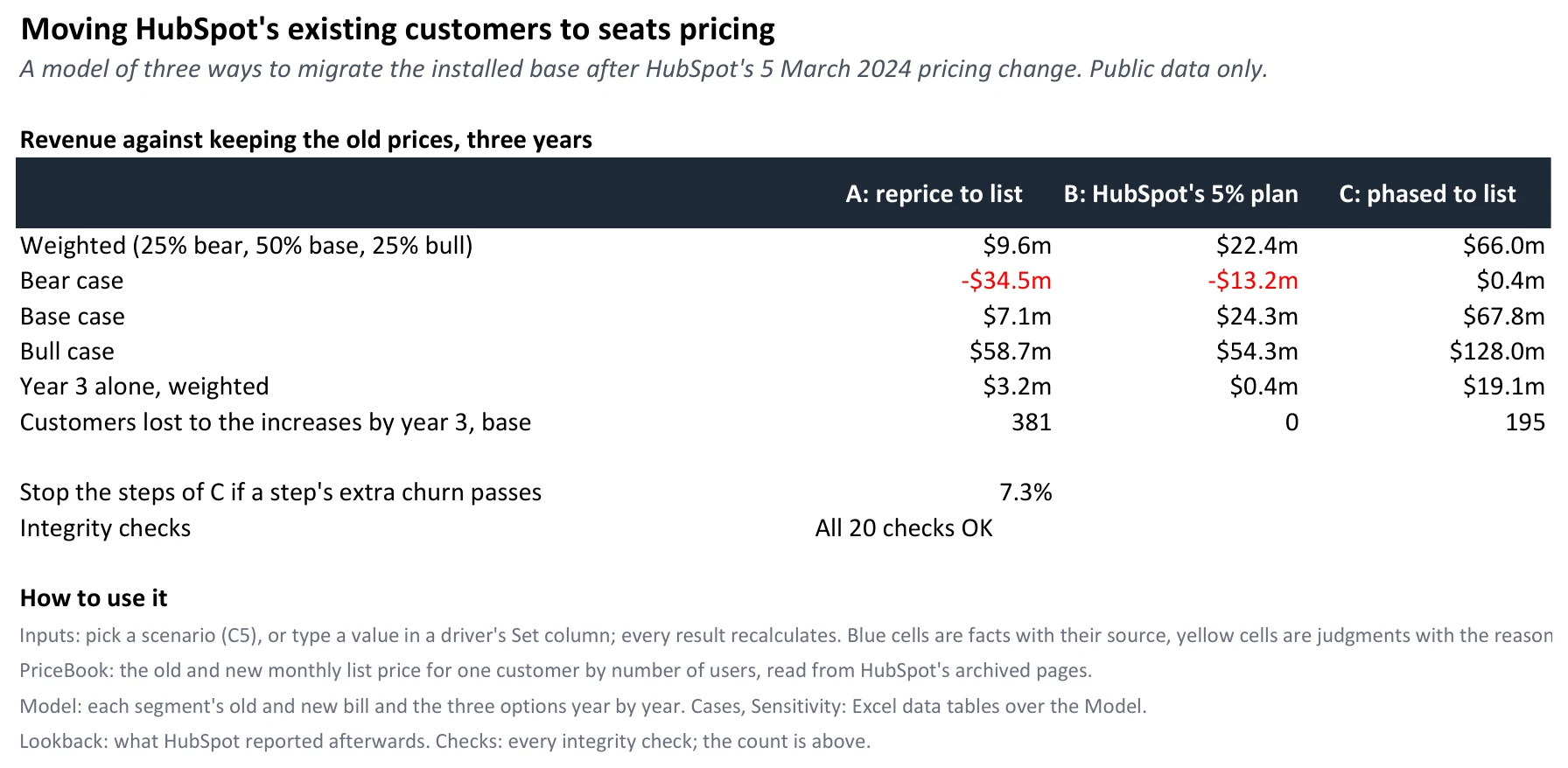
Recommendation. Move existing customers to seats at the price they pay today, then raise only the accounts whose new list price is higher, by at most 10% of the bill at each renewal until they reach list; leave accounts whose new list price is lower on their current bill until they ask to remove seats; and stop the steps if accounts that take one leave at a rate 7.3 points above comparable accounts that do not. Over three years this adds $66.0m of subscription revenue against keeping the old prices, weighted across my three scenarios, against $22.4m for the 5% plan HubSpot announced and $9.6m for moving everyone to the new list at once. It is the best of the three in every scenario, and it roughly breaks even ($0.4m) in the bear case, where the other two lose money.
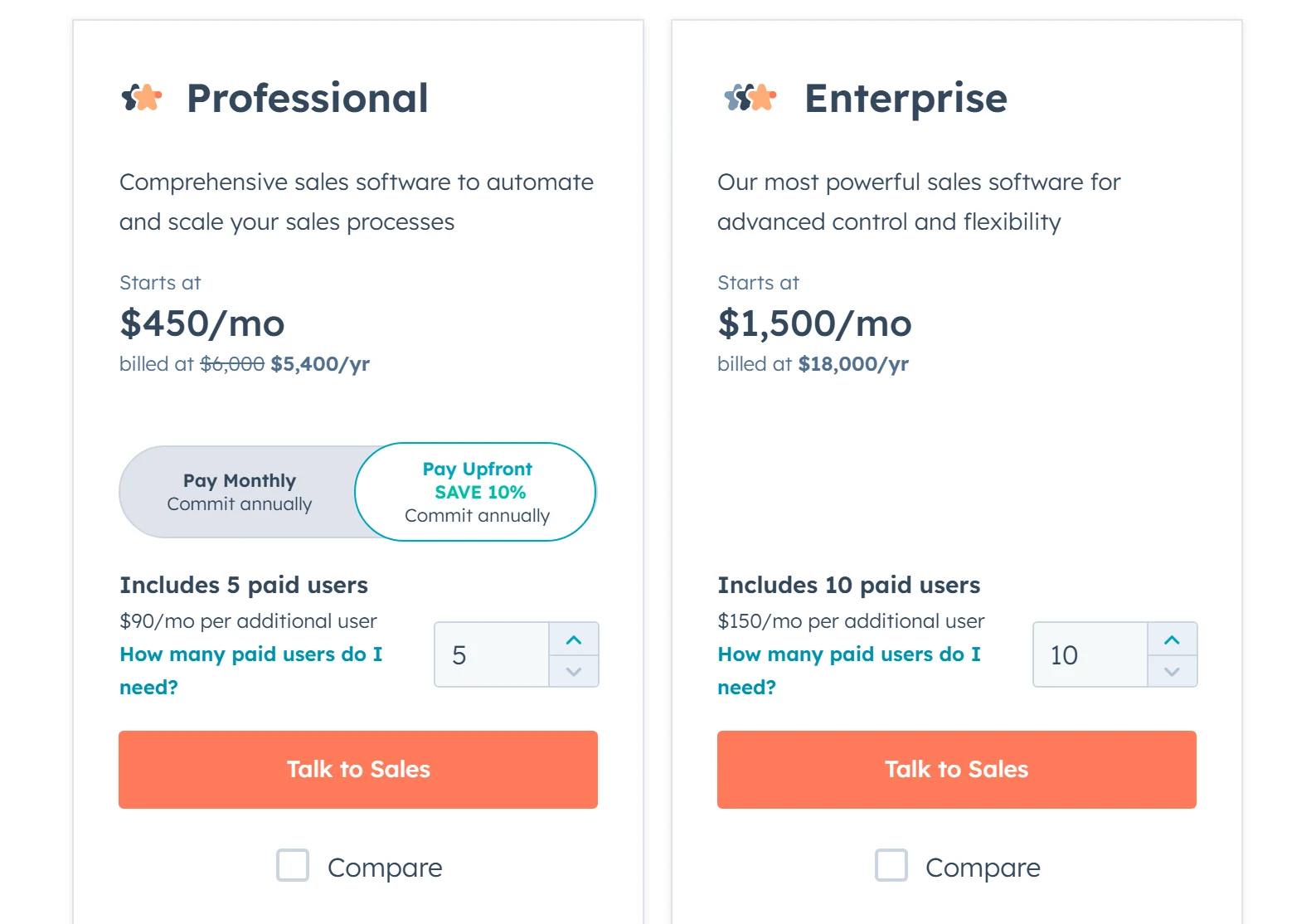
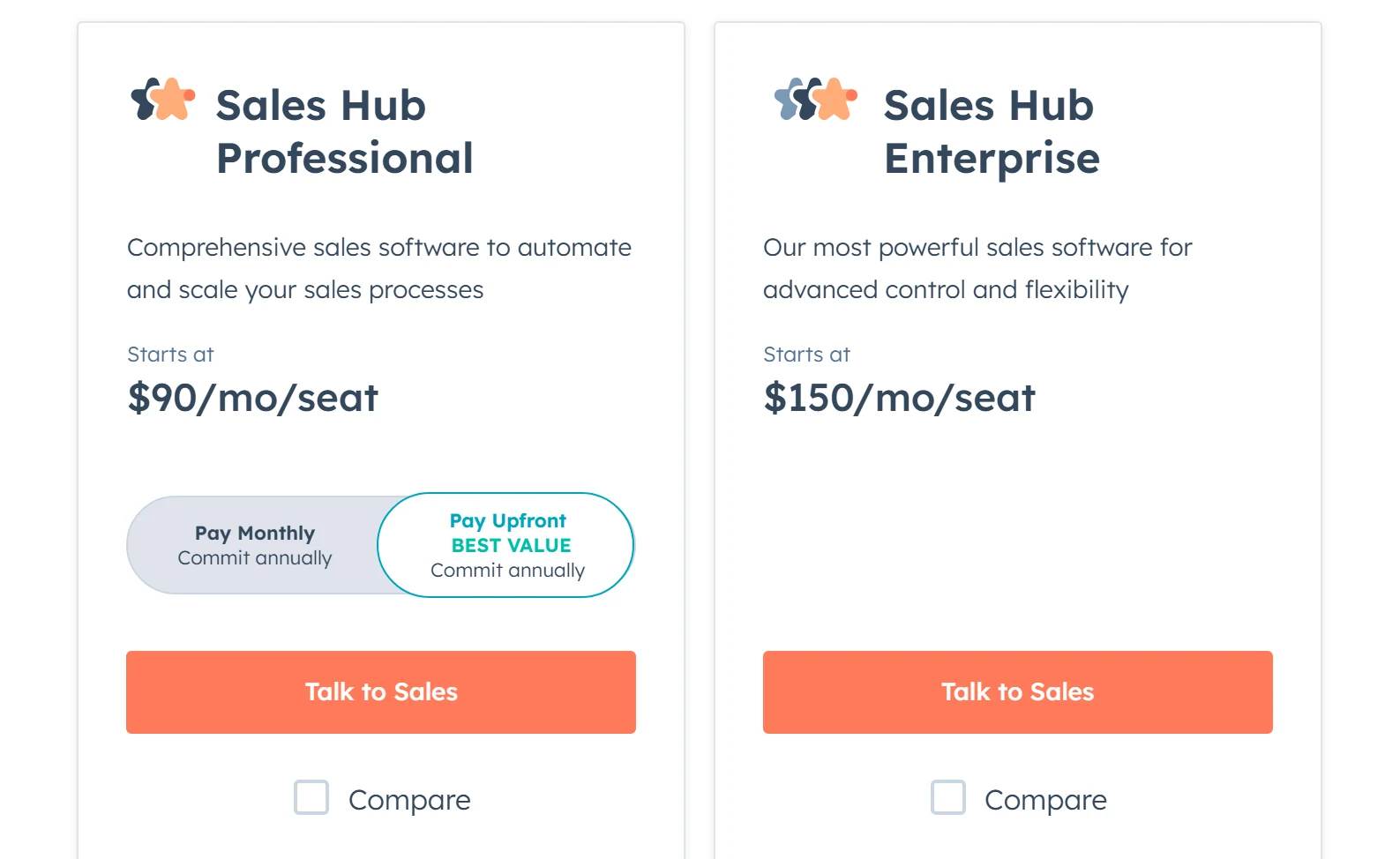
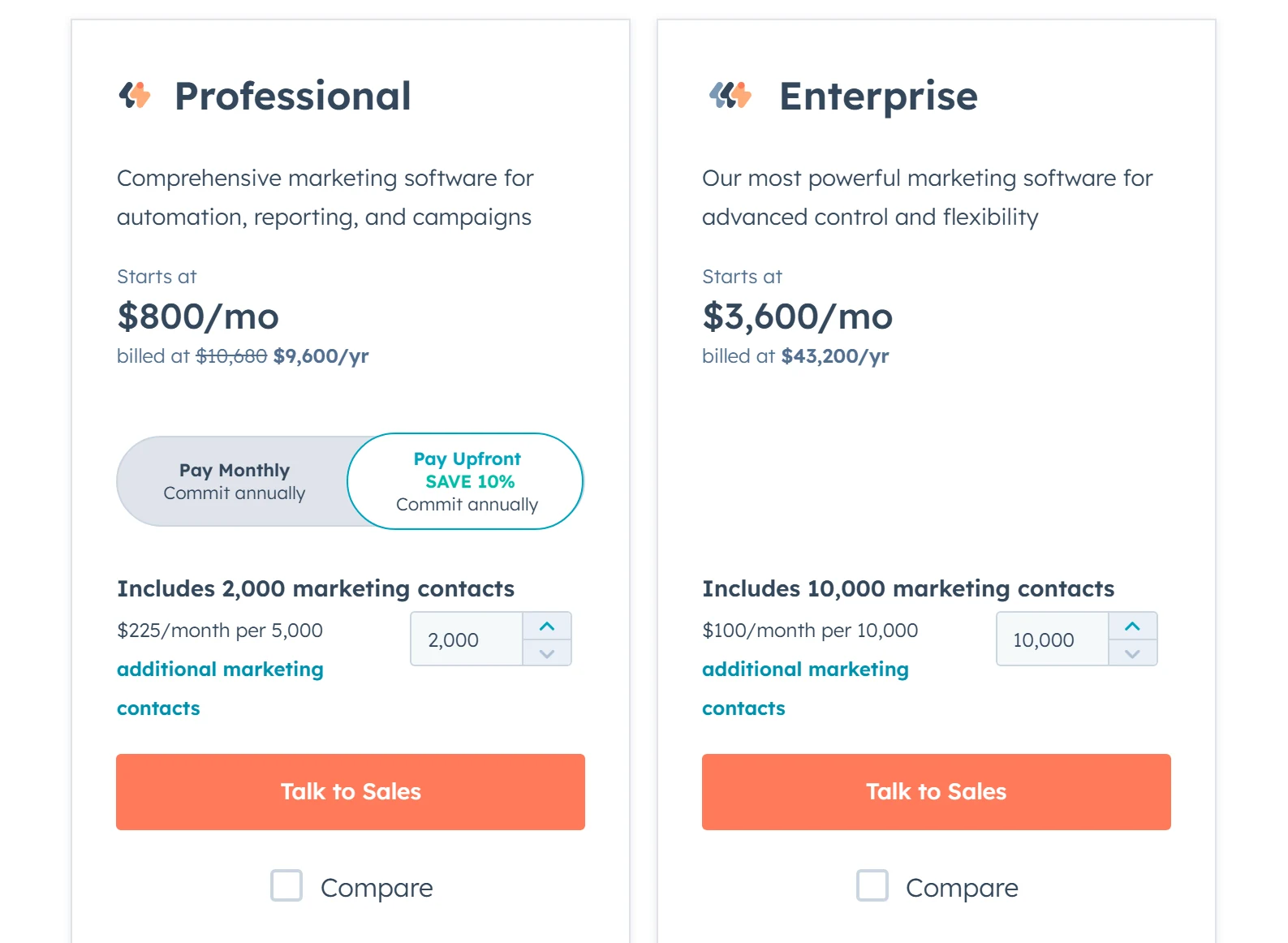
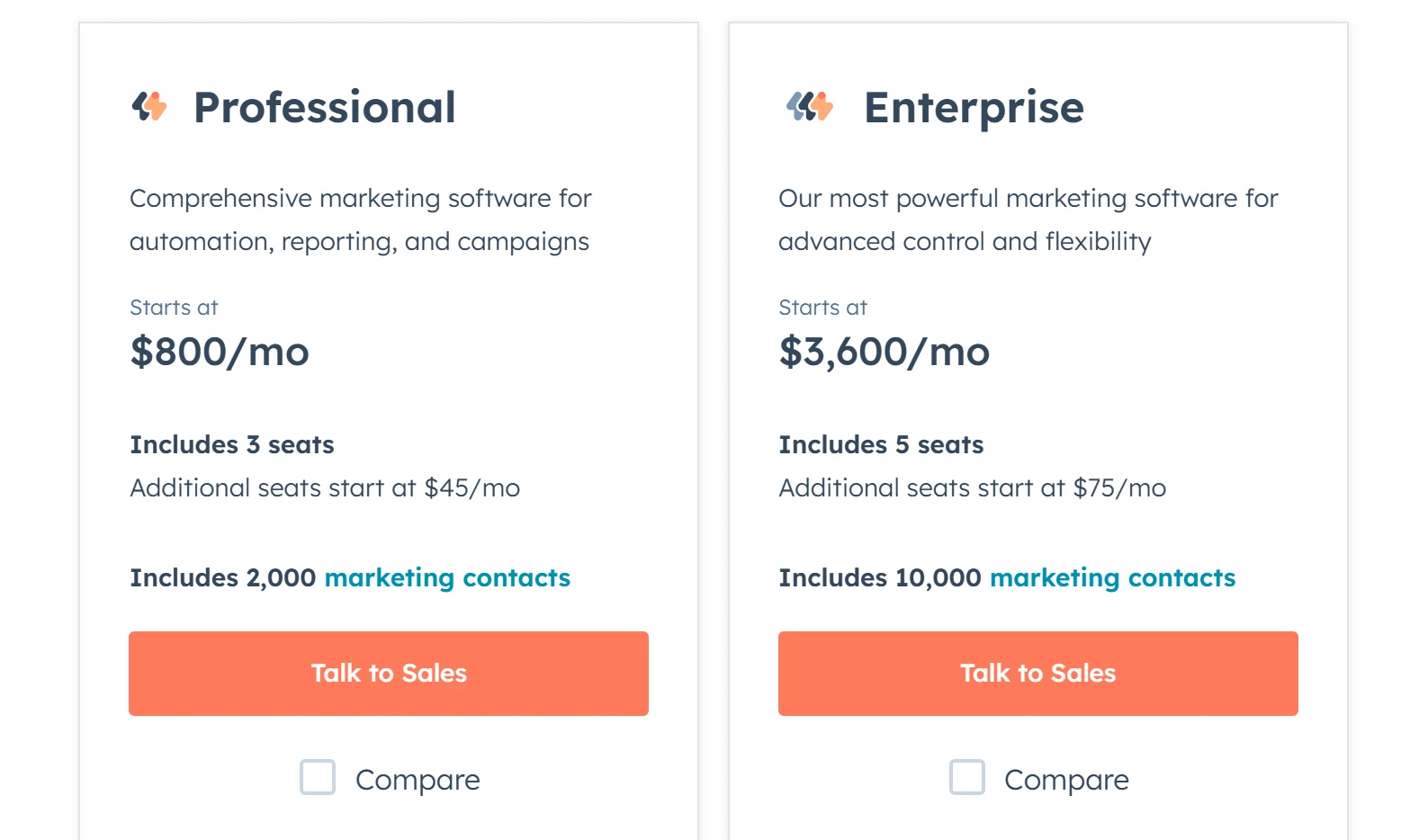
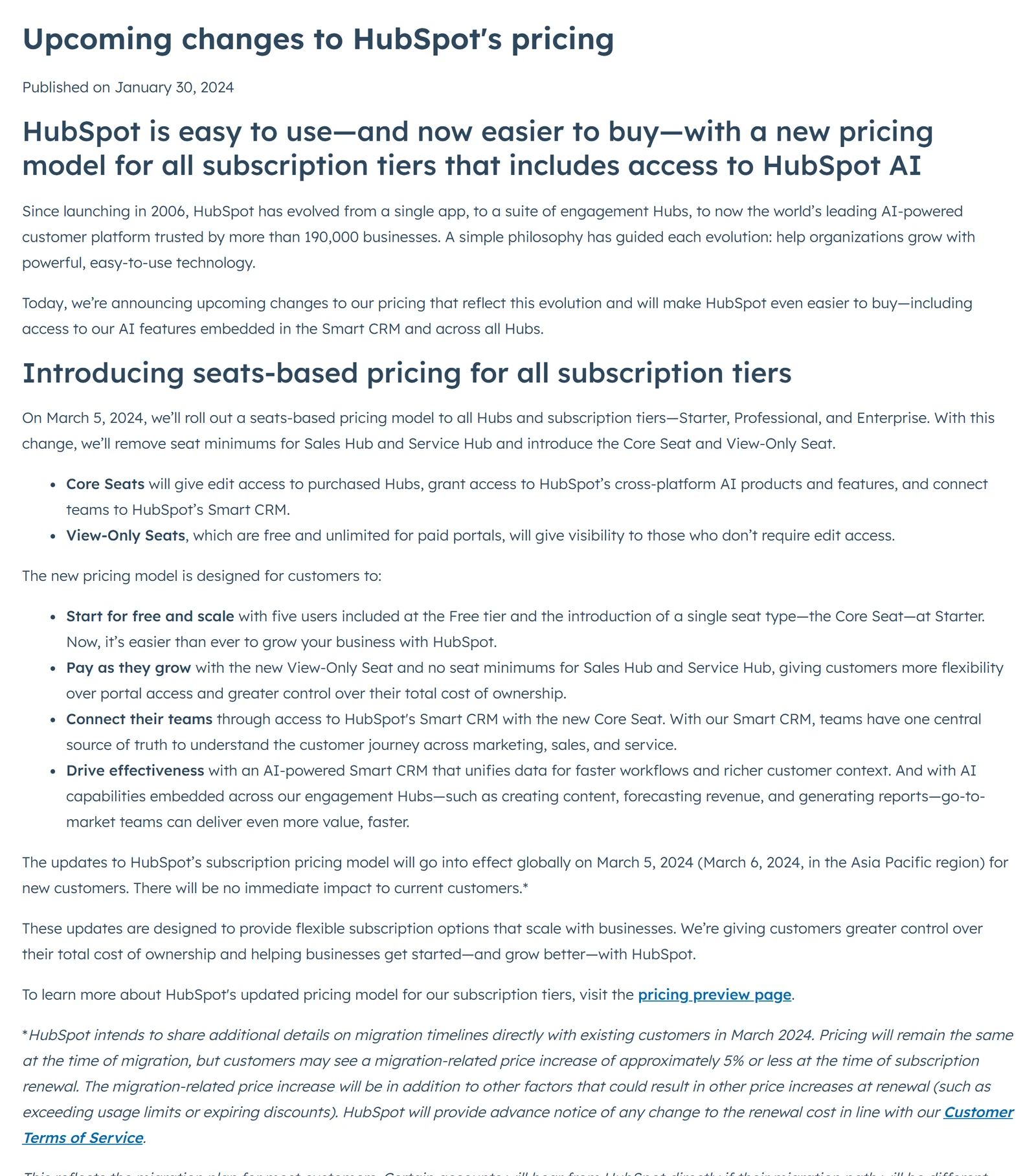
What HubSpot changed. On 5 March 2024 HubSpot moved new customers to seats-based pricing for all Hubs and tiers. In its words, it would “remove seat minimums for Sales Hub and Service Hub and introduce the Core Seat and View-Only Seat”; view-only seats are free and unlimited for paid portals. Its archived pricing pages show what that meant. Sales Hub Professional went from $450 a month including 5 paid users, plus $90 for each additional user, to $90 a month per seat; Sales Hub Enterprise went from $1,500 including 10 paid users, plus $150 each, to $150 per seat. Marketing Hub kept its $800 and $3,600 monthly prices, but where the January 2024 page priced no seats at all, the March page includes 3 and 5 seats, with additional seats from $45 and $75 a month. For existing customers HubSpot said: “Pricing will remain the same at the time of migration, but customers may see a migration-related price increase of approximately 5% or less at the time of subscription renewal.”
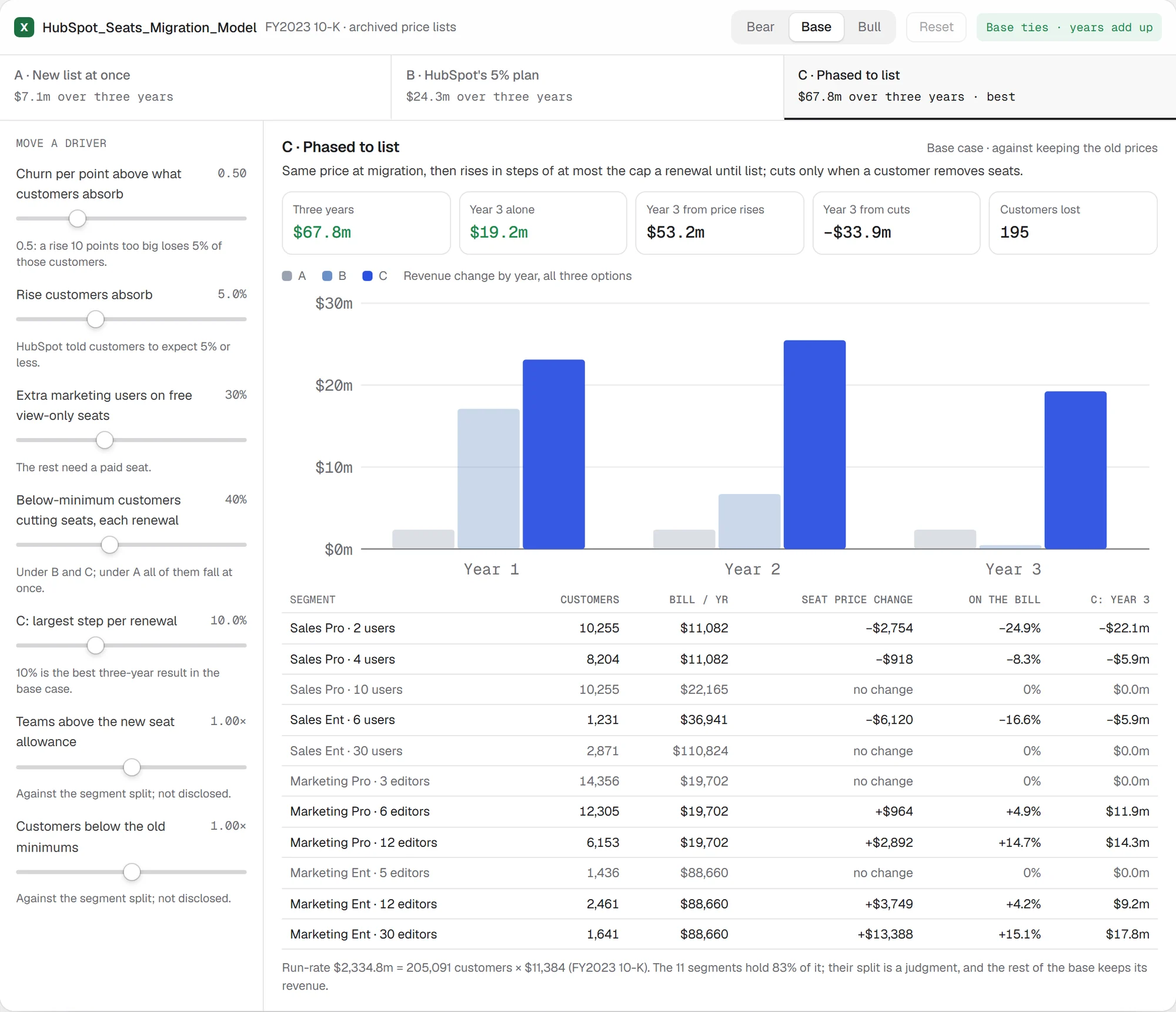
What it does to the existing base. So only two groups see a different bill: Sales Hub customers with fewer users than the old minimums pay less, and Marketing Hub teams with more editors than the included seats pay more. Everyone else pays the same. I anchor the base on the FY2023 10-K: 205,091 customers at $11,384 a year each, a run-rate of $2,334.8m. HubSpot does not report customers by Hub, tier or team size, so the split into eleven segments is my judgment, tied to those two numbers. At the full new list, the customers whose price rises would pay $60.8m a year more and those whose price falls $43.3m a year less. How fast each of those arrives, and how many customers leave over a rise, is what separates the three ways to migrate.
The three options.
| Three years against the old prices | Bear | Base | Bull | Weighted |
|---|---|---|---|---|
| A: everyone to the new list at the first renewal | −$34.5m | $7.1m | $58.7m | $9.6m |
| B: HubSpot's plan, same price, then at most 5% | −$13.2m | $24.3m | $54.3m | $22.4m |
| C: same price, then steps of at most 10% to list | $0.4m | $67.8m | $128.0m | $66.0m |
The scenarios move three judgments together: how many customers leave per point of increase above the 5% they absorb (0.25 in the bull case, 0.50 in the base case, 0.80 in the bear case), what share of extra Marketing Hub users take a free view-only seat instead of a paid one (15% to 45%), and what share of customers below the old minimums remove seats at each renewal (25% to 60%). In the base case's first year C adds 0.99 points of net revenue retention, against 103.9% in 2023; A adds 0.10. Weights are 25%, 50% and 25%.
The options I rejected. Moving everyone to the new list at once (A) is the cleanest for billing, but it hands the whole $43.3m a year cut to the price-down customers at their first renewal, before any of the upside arrives, and the one-time rises lose about 381 customers in the base case. It loses $34.5m in the bear case. HubSpot's announced plan (B) loses no customers to price in the model, because no increase passes the 5% I assume customers absorb, but it stops there: by the third year it collects $34.4m from the price-up customers against $53.2m under C, while giving away exactly the same $33.9m to seat cuts. C beats it by $13.6m even in the bear case, and by at least $16.8m at every point of the two-way table on the two drivers that matter most.
Why steps of 10%. The cap curve on the Sensitivity sheet runs C with every step size from 0% to 30%. Steps of 10% give the most over three years in the base case, $67.8m; steps of 5% give $64.7m; a cap of 15% gives $58.1m and larger caps slightly less, because one larger rise costs more customers than it brings in. The stop trigger comes from the churn curve: C stays ahead of B until each point of increase above 5% costs 1.46 points of churn, against 0.50 in the base case. A 10% step is 5 points above what customers absorb, so the trigger is 7.3 points more churn among accounts that took a step than among those that did not, read at each renewal cohort; if it is crossed, fall back to B for the accounts not yet at list.
What would change my view. The result depends most on the customer mix, which HubSpot knows from its billing data and I do not. With half as many Marketing Hub teams above the included seats, C's three-year gain falls to −$5.0m; with half again as many Sales Hub customers below the old minimums, it falls to $27.1m. Those two counts are the first numbers to replace. If 60% of the price-down customers cut seats at every renewal, C still gains $43.9m; if churn per point is above 1.46, B is the better plan.
Risks and what the model leaves out. Leaving price-down customers on their old bill until they ask sits uneasily with an announcement that promised more control over the total cost of ownership; telling every such customer at migration that they can drop unused seats at renewal is part of the plan, and the model already assumes many of them will. The model covers existing Sales Hub and Marketing Hub customers on Professional and Enterprise. It leaves out Service Hub (its pricing page before the change does not load in the archive, and its May 2024 page announced a further rise in Enterprise seats for 24 June 2024), Starter, new customers, customers holding several Hubs, add-on and contact charges, onboarding fees and the growth a seat-based customer adds over time. Discounts, the split into segments, churn per point and the view-only share are my judgments; the Inputs sheet gives the reason for each.
What happened afterwards. HubSpot's later filings cannot separate the migration from new customers, so they neither confirm nor refute this model. They do name the change: the 10-Qs for the second and third quarters of 2024 give “the impact of our new seats pricing model” as one reason average subscription revenue per customer fell, and the FY2024 10-K says the same for the year, when it went from $11,384 to $11,343 while customers grew to 247,939. Net revenue retention was 103.9% in 2023 and 102.2% in 2024 as first reported; the FY2025 10-K restates both on a new method.