Public dataSEC filings · Nasdaq: META

Business cases and capital allocation

Reality Labs investment memo

A two-page memo on whether Meta should keep funding Reality Labs, with the driver model under it, built from Meta's SEC filings through the 10-Q it filed on 22 October 2026. It recommends a smaller, gated bet on AI glasses: stop VR and Horizon, halve the glasses budget, and decide on the FY2028 10-K whether to go on.

The Reality Labs decision running in the browser: the four options with their NPV against stopping, the scenario switch, driver sliders, the yearly cash flows and the stop conditions.

The memo

Two pages to Meta's CFO, written from public filings only. The first sentence is the recommendation; every number in it is read from the workbook after Excel recalculates it.

Download the PDF · 116 KB

Should Meta keep funding Reality Labs?

ToMeta's CFO (an exercise on public filings)
Date23 October 2026, after the Q3 2026 10-Q
QuestionShould Meta keep funding Reality Labs?
BasisWorkbook, all 21 checks OK

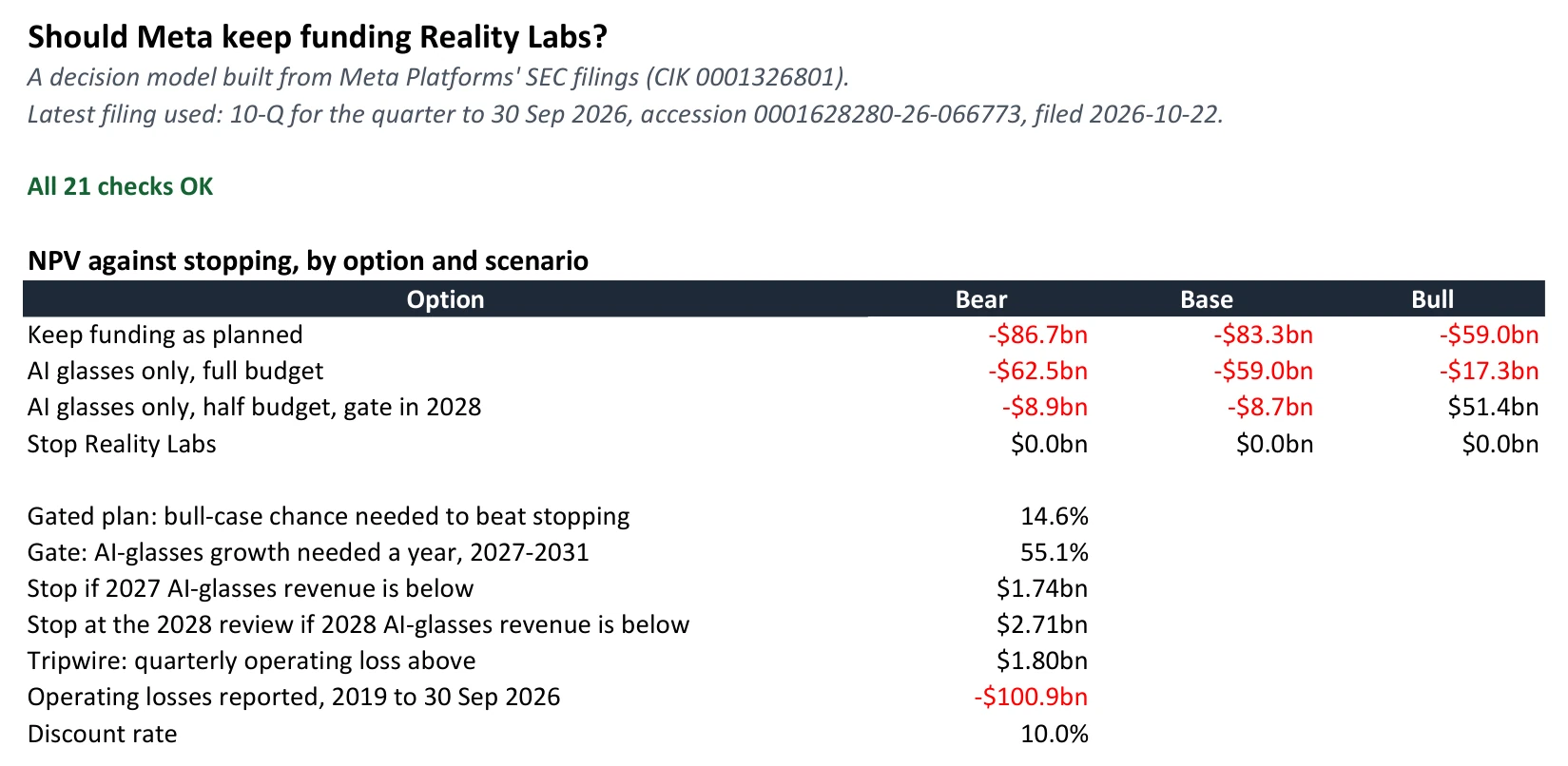
Recommendation. Keep funding Reality Labs only as a smaller, gated bet on AI glasses: stop VR and Horizon in 2027, cut AI-glasses spending to about $6.9bn a year, half of this year's level, for 2027 and 2028, and carry on after the FY2028 10-K only if AI-glasses revenue has grown at least 55% a year. At its current size Reality Labs does not pay back in any of my three scenarios: against shutting it down, keeping it as planned is worth −$83.3bn in the base case and still −$59.0bn if AI glasses become a mass product. The gated plan loses at most $8.9bn if AI glasses disappoint and is worth $51.4bn if they take off, so it beats stopping whenever that bull case has more than a 15% chance (with bear and base otherwise equally likely).

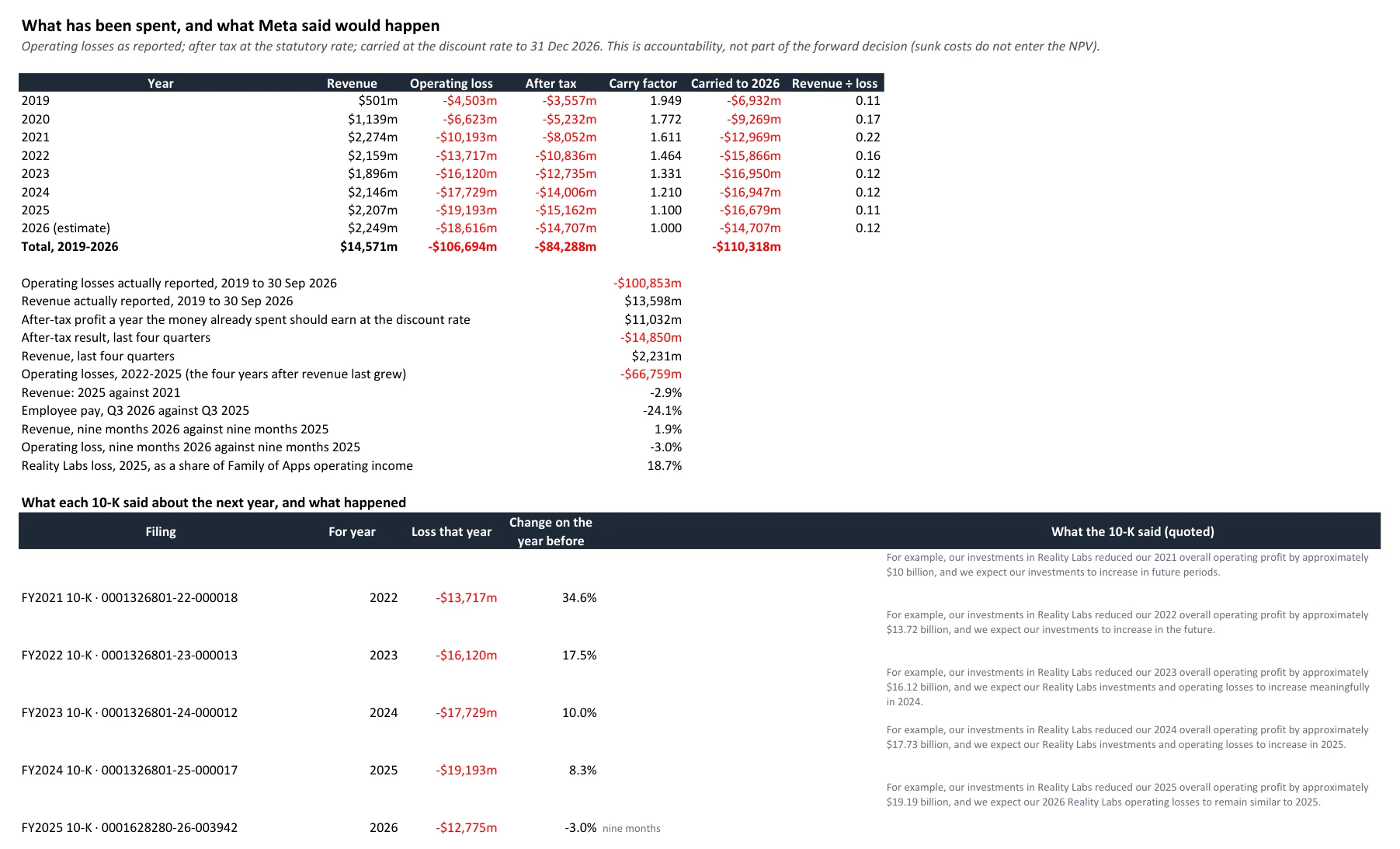
What the money has bought so far. From 2019 to 30 September 2026 Reality Labs reported $100.9bn of operating losses and $13.6bn of revenue. Revenue was $2.27bn in 2021 and $2.21bn in 2025: four more years and $66.8bn of further losses left it 2.9% lower. The FY2021 and FY2022 10-Ks said Reality Labs investment would increase, the FY2023 and FY2024 10-Ks said its operating losses would too, and the loss rose every year, from $10.19bn in 2021 to $19.19bn in 2025. The FY2025 10-K said 2026 would be similar, and the first nine months are 3.0% below last year's. No filing states a revenue goal; since 2023 each one says Reality Labs has "generated only limited revenue." Counting the spending through the end of 2026, with this year's fourth quarter estimated, and carrying it at 10% after tax, the money spent would have to earn $11.0bn a year just to cover its cost of capital; the last four quarters lost $14.9bn after tax. That money is sunk and is not part of the decision below, but it is the record the next budget should be held to.

The four options. Each option is valued against shutting Reality Labs down in 2027, after tax, at a 10% discount rate, from 2027 to 2036 plus a terminal value.

NPV against stoppingBearBaseBull
Keep funding as planned−$86.7bn−$83.3bn−$59.0bn
AI glasses only, full budget−$62.5bn−$59.0bn−$17.3bn
AI glasses only, half budget, gate in 2028−$8.9bn−$8.7bn$51.4bn
Stop Reality Labs$0.0bn$0.0bn$0.0bn

Keeping Reality Labs as planned never pays back within ten years in any scenario; to break even in the base case, AI-glasses revenue would have to grow about 93% a year for five years. Funding AI glasses alone at the full budget is better but still loses money in the bull case, because it carries about $13.7bn a year of fixed spend; it would need about 85% growth a year. Stopping costs about $5.2bn once, before tax, and nothing after that. The gated plan loses $8.9bn in the bear case and $8.7bn in the base case, because the 2028 review shuts it in both; in the bull case it returns 36% a year and pays back in 2036.

The options I rejected. I rejected keeping Reality Labs as planned, which is Meta's stated plan for 2026, because no scenario I can support from the filings earns back its cost. Spend growth and the discount rate move its value most, and even the best pairing of the two that I tested, spend falling 5% a year and a 12% discount rate, since a higher rate shrinks today's value of future losses, leaves it at −$59.4bn. Stopping everything now is the closer call, and it is the right answer if you give AI glasses less than a 15% chance of becoming a mass product. I chose the gated plan over it for three reasons. Its worst case, $8.9bn, is small next to the $83.3bn the current plan costs in the base case. AI glasses are the only part of Reality Labs whose sales are growing: six of the seven filings since Q1 2025 say the change in revenue came from AI glasses up and Quest down. And Meta is already moving this way, with 70% of its 2026 Reality Labs spending going to wearables and Reality Labs employee pay in Q3 2026 24% below a year earlier.

Stop conditions for the gated plan.

  1. Every quarter: stop if Reality Labs' operating loss, leaving out wind-down charges, is above $1.80bn two quarters running: 10% over a quarter of the plan's base-case 2027 loss of $6.55bn.
  2. On the FY2027 10-K: stop a year early if 2027 AI-glasses revenue is below $1.74bn.
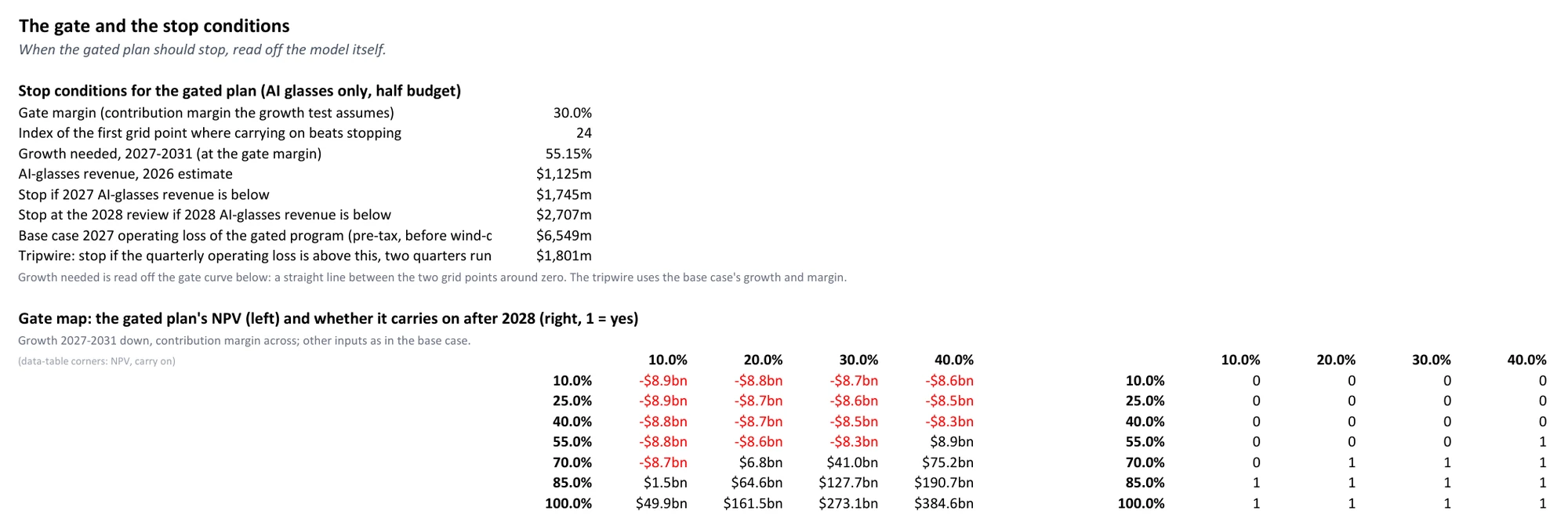
  3. On the FY2028 10-K: stop unless 2028 AI-glasses revenue is at least $2.71bn, growth of 55% a year from an estimated $1.12bn in 2026, at a contribution margin of at least 30%. With a lower margin the growth needed is higher; the gate map on the Gate sheet shows the trade.
  4. Review at once if Meta books another loss on non-cancelable Reality Labs inventory commitments, as it did in 2025: it is the first sign that demand is below plan.

Once VR stops, Reality Labs revenue in the 10-Q is almost all AI glasses, so the second and third tests can be read from outside the company; inside Meta they can be read every month.

What would change my view. Three things would make me fund AI glasses more, not less: 2027 glasses revenue above the bull path's $1.91bn; evidence that the margin is above 30%, for example if Meta began reporting Reality Labs cost of revenue; or proof that the glasses bring in money the segment is not credited with, such as use of Meta AI that lifts Family of Apps revenue. For funding AI glasses at the full budget to break even in the base case, that outside benefit would have to be about $9.6bn a year after tax. A partner paying part of the development would work like a smaller budget.

Risks and what the model leaves out. The model values only Reality Labs' own revenue. If AI glasses turn out to be how people reach Meta's AI, losing that position could cost the rest of Meta more than anything counted here; that is the case for keeping the gate open instead of stopping. Halving the budget may also slow the product. The model does not let a smaller budget slow growth, so it flatters the cut, and the 2028 gate is what would catch it. Meta does not disclose glasses revenue, margin or cost, so the 50/50 revenue split between AI glasses and Quest, the margins and the growth rates are my judgments; the 70/30 cost split is Meta's statement for 2026 operating expenses, applied here to all costs. The bull case is large: its 2036 AI-glasses revenue of $57.1bn is 1.6 times Apple's fiscal 2025 Wearables, Home and Accessories sales ($35.7bn), and all of its value comes from after 2036: the terminal value alone is worth $54.0bn. Losses are valued after a 21% tax saving, which assumes the rest of Meta stays profitable, and at a 10% discount rate against effective rates of 4.27% to 5.77% on Meta's newest notes.

Basis. Every number comes from Meta_Reality_Labs_Investment_Model.xlsx after Excel recalculation (all 21 checks OK). The facts are from Meta's 10-K filings for 2021 to 2025 and its 10-Q filings through Q3 2026 (latest accession 0001628280-26-066773, filed 22 October 2026); each accession number is on the Inputs and History sheets. 2026 is estimated as the first nine months plus last year's fourth quarter grown at the nine-month rate, which gives an operating loss of $18.6bn. The three scenarios differ in four judgments, set out on the Inputs sheet: AI-glasses growth for 2027 to 2031 (10%, 35%, 70% a year), Quest's yearly change, long-run growth, and the contribution margin (10%, 20%, 30%). This is an exercise on public filings, not investment advice.
The model

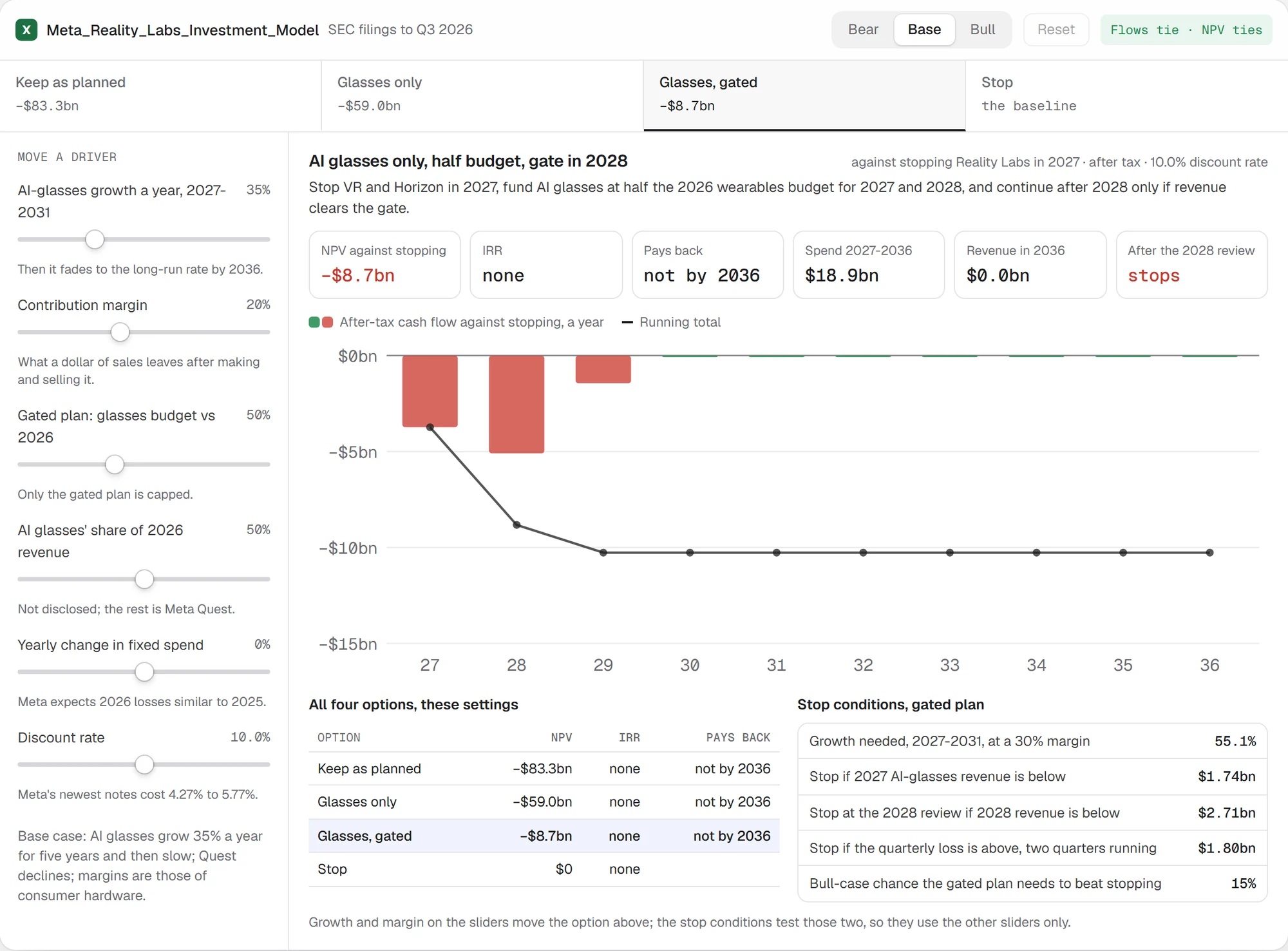
Pick an option and a scenario, or move a driver, and the cash flows, NPV, IRR, payback and stop conditions recalculate. The logic is the workbook's, line for line.

Download .xlsx · 48 KB
Meta_Reality_Labs_Investment_ModelSEC filings to Q3 2026
Flows tie · NPV ties

AI glasses only, half budget, gate in 2028

against stopping Reality Labs in 2027 · after tax · 10.0% discount rate

Stop VR and Horizon in 2027, fund AI glasses at half the 2026 wearables budget for 2027 and 2028, and continue after 2028 only if revenue clears the gate.

NPV against stopping
−$8.7bn
IRR
none
Pays back
not by 2036
Spend 2027-2036
$18.9bn
Revenue in 2036
$0.0bn
After the 2028 review
stops
After-tax cash flow against stopping, a yearRunning total
−$15bn−$10bn−$5bn$0bn27282930313233343536

All four options, these settings

OptionNPVIRRPays back
Keep as planned−$83.3bnnonenot by 2036
Glasses only−$59.0bnnonenot by 2036
Glasses, gated−$8.7bnnonenot by 2036
Stop$0none

Stop conditions, gated plan

  • Growth needed, 2027-2031, at a 30% margin55.1%
  • Stop if 2027 AI-glasses revenue is below$1.74bn
  • Stop at the 2028 review if 2028 revenue is below$2.71bn
  • Stop if the quarterly loss is above, two quarters running$1.80bn
  • Bull-case chance the gated plan needs to beat stopping15%

Growth and margin on the sliders move the option above; the stop conditions test those two, so they use the other sliders only.

How it was built. I built it with an AI agent system I run. It wrote the pipeline and the workbook to my brief, I went through it myself, and a separate check re-derives its figures from the source data. Every input comes from Meta's 10-K and 10-Q filings, with its accession number, or is labelled as a judgment with the reason for it.

Summary
The workbook's summary: NPV against stopping for four options in three scenarios, the bull-case chance the gated plan needs, and the stop thresholds
Against shutting it down, keeping Reality Labs as planned is worth −$83.3bn in the base case and −$59.0bn in the bull case. The gated plan on AI glasses loses at most $8.9bn and is worth $51.4bn in the bull case, so it beats stopping if that case has more than a 15% chance.
Gate
The workbook's Gate sheet: the stop conditions and the gate map of NPV and carry-on by growth and margin
The gate is read off the model: carrying on after 2028 pays only if AI-glasses revenue grows at least 55% a year at a 30% margin. That means $1.74bn in 2027 and $2.71bn in 2028; below either, the plan stops.
Lookback
The workbook's Lookback sheet: Reality Labs revenue and losses by year since 2019, and what each 10-K said about the next year
Reality Labs reported $100.9bn of operating losses from 2019 to September 2026 and $13.6bn of revenue. The FY2021 and FY2022 10-Ks said its investment would increase, the FY2023 and FY2024 10-Ks said its operating losses would, and the loss rose every year, from $10.19bn in 2021 to $19.19bn in 2025, while revenue went from $2.27bn to $2.21bn.

The full analysis

Each part opens on click.

Why Reality LabsFive candidates, scored on what their filings disclose and on how well they fit a tech finance interview

The investment had to be one a public company reports on its own, with its spending and its results, over several periods. I scored five candidates from 1 to 5 on each test, after reading the segment facts in each company's latest 10-Q.

Company · investmentDataFitWhat the filings giveWhy it does or does not fit
Meta Platforms · Reality Labs (AI glasses, VR, Horizon)55Segment revenue and operating loss every quarter since Q1 2021 (yearly from 2019); employee pay and other costs split out from 2022; each 10-K states the next year's expected loss and how the spend splits; the 10-Qs name what moved revenue.The most argued-over capital allocation in big tech, about $100B of losses so far, and a decision that is live in late 2026.
Alphabet · Other Bets (Waymo and others)34Revenue and operating loss as an 'all other' segment, no cost split, no stated expectations; Waymo is not reported on its own.A good question, but the money is spread over several unrelated bets, so 'keep funding' has no single answer.
Alphabet · Google Cloud43Revenue, operating income, employee pay and backlog by segment; capital spending is not split by segment.The losses turned into profit in 2023; 'keep funding' is now an AI-capex question that the segment numbers cannot answer.
Uber · Freight32Segment revenue and operating result; no measures beyond revenue; most of the investment was one acquisition.Close to break-even and small next to Mobility and Delivery, so there is little to decide.
Coupang · Developing Offerings (Taiwan, Eats, Play, Farfetch)43Revenue, gross profit and adjusted EBITDA by segment, so a margin is disclosed.The segment mixes four businesses, one of them an acquisition, so no single investment can be judged.

Reality Labs scores highest on both. Meta reports its revenue and operating loss every quarter, splits its costs into employee pay and everything else, says in each 10-K what it expects Reality Labs to lose next year and how the spending will split, and names what moved revenue in each 10-Q. It is also the capital-allocation question people in tech finance argue about most, and it is live: the latest 10-Q came out on 22 October 2026.

What has been spent, and what Meta said would happenLosses as reported since 2019, and each 10-K's statement about the next year
YearRevenueOperating lossRevenue per $1 of lossAccession
2019$501m−$4,503m$0.110001326801-22-000018
2020$1,139m−$6,623m$0.170001326801-22-000018
2021$2,274m−$10,193m$0.220001326801-22-000018
2022$2,159m−$13,717m$0.160001326801-23-000013
2023$1,896m−$16,120m$0.120001326801-24-000012
2024$2,146m−$17,729m$0.120001326801-25-000017
2025$2,207m−$19,193m$0.110001628280-26-003942
2026, nine months$1,276m−$12,775m$0.100001628280-26-066773

In total that is $100.9bn of operating losses for $13.6bn of revenue. After tax at 21% and carried at a 10% return to the end of 2026 (with this year estimated), the money already spent would have to earn $11.0bn a year after tax just to cover its cost; the last four quarters lost $14.9bn after tax. None of this enters the forward decision, because the money is spent either way, but it is the record the next budget should be held to.

FilingAboutLoss that yearChangeWhat the 10-K said
FY2021 10-K
0001326801-22-000018
2022−$13,717m35%For example, our investments in Reality Labs reduced our 2021 overall operating profit by approximately $10 billion, and we expect our investments to increase in future periods.
FY2022 10-K
0001326801-23-000013
2023−$16,120m18%For example, our investments in Reality Labs reduced our 2022 overall operating profit by approximately $13.72 billion, and we expect our investments to increase in the future.
FY2023 10-K
0001326801-24-000012
2024−$17,729m10%For example, our investments in Reality Labs reduced our 2023 overall operating profit by approximately $16.12 billion, and we expect our Reality Labs investments and operating losses to increase meaningfully in 2024.
FY2024 10-K
0001326801-25-000017
2025−$19,193m8%For example, our investments in Reality Labs reduced our 2024 overall operating profit by approximately $17.73 billion, and we expect our Reality Labs investments and operating losses to increase in 2025.
FY2025 10-K
0001628280-26-003942
2026, nine months−$12,775m−3%For example, our investments in Reality Labs reduced our 2025 overall operating profit by approximately $19.19 billion, and we expect our 2026 Reality Labs operating losses to remain similar to 2025.

No filing states a revenue goal for Reality Labs. Each 10-K since FY2022 has said how next year's Reality Labs operating expenses would split, and the split has moved toward wearables:

FY2022 10-K, for 2023

“For example, in 2023, we expect to spend approximately 50% of our Reality Labs operating expenses on our augmented reality initiatives, approximately 40% on our virtual reality initiatives, and approximately 10% on social platforms and other initiatives.” (0001326801-23-000013)

FY2023 10-K, for 2024

“For example, in 2024, we expect to spend approximately 50% of our Reality Labs operating expenses on our AR initiatives, approximately 40% on our VR (including MR) initiatives, and approximately 10% on social platforms and other initiatives.” (0001326801-24-000012)

FY2024 10-K, for 2025

“For example, in 2025, we expect to spend approximately 50% of our Reality Labs operating expenses on our wearables initiatives, and the remaining 50% on our metaverse initiatives.” (0001326801-25-000017)

FY2025 10-K, for 2026

“In 2026, we expect to spend approximately 70% of our Reality Labs operating expenses on our wearables initiatives, and the remaining 30% on our VR and Horizon initiatives.” (0001628280-26-003942)

And what each filing since 2025 says moved Reality Labs revenue:

10-Q · 2025-03-31

“The decrease in RL revenue was driven by a net decrease in Meta Quest sales, partially offset by an increase in sales of Ray-Ban Meta AI glasses.” (0001326801-25-000054)

10-Q · 2025-06-30

“RL revenue in the three months ended June 30, 2025 increased $17 million, or 5%, compared to the same period in 2024, driven by an increase in sales of Ray-Ban Meta AI glasses, partially offset by a net decrease in Meta Quest sales.” (0001628280-25-036791)

10-Q · 2025-09-30

“RL revenue in the three months ended September 30, 2025 increased $200 million, or 74%, compared to the same period in 2024, mostly due to increases in sales of Meta Quest and AI glasses.” (0001628280-25-047240)

10-K · 2025-12-31

“The increase was driven by an increase in sales of AI glasses, partially offset by a decrease in Meta Quest sales.” (0001628280-26-003942)

10-Q · 2026-03-31

“The decrease was driven by lower Meta Quest sales, offset by an increase in sales of AI glasses.” (0001628280-26-028526)

10-Q · 2026-06-30

“The increases were driven by higher sales of AI glasses, partially offset by lower Meta Quest sales.” (0001628280-26-050705)

10-Q · 2026-09-30

“The decrease was driven by lower Meta Quest sales, partially offset by higher sales of AI glasses.” (0001628280-26-066773)

Options, scenarios and assumptionsEvery judgment with its reason; every fact with the filing it comes from
OptionWhat it doesBearBaseBull
Keep funding as plannedReality Labs keeps its 2026 budget (Meta's own split: 70% wearables, 30% VR and Horizon), flat from there.−$86.7bn−$83.3bn−$59.0bn
AI glasses only, full budgetStop VR and Horizon in 2027 and keep the whole 2026 wearables budget.−$62.5bn−$59.0bn−$17.3bn
AI glasses only, half budget, gate in 2028Stop VR and Horizon in 2027, fund AI glasses at half the 2026 wearables budget for 2027 and 2028, and continue after 2028 only if revenue clears the gate.−$8.9bn−$8.7bn$51.4bn
Stop Reality LabsWind the whole segment down in 2027. Every other option is measured against this one.$0$0$0

Each option is valued against stopping Reality Labs in 2027: yearly cash flows for 2027 to 2036 after tax at the statutory rate, discounted at the end of each year, plus a terminal value on the 2036 flow if it is positive. The fixed spend of each line is its 2026 costs less the cost of what it sells; stopping a line costs a quarter of its yearly costs once. 2026 is estimated as the first nine months plus last year's fourth quarter grown at the nine-month rate: revenue $2.25bn, operating loss $18.62bn, 3.0% below 2025, in line with the FY2025 10-K's expectation that 2026 would be similar.

Scenario driverBearBaseBullBasis
AI-glasses growth a year, 2027-203110%35%70%AI-glasses revenue growth a year, 2027-2031, fading to the long-run rate by 2036. No glasses revenue is disclosed.
Long-run growth2%3%4%Long-run growth after 2036 (the fade target and the terminal value).
Meta Quest revenue change a year−30%−15%−5%Meta Quest revenue change a year, while VR is funded. Six of the seven filings since Q1 2025 name lower Quest sales.
Contribution margin10%20%30%Contribution margin: what a dollar of Reality Labs sales leaves after the cost of making and selling it. Meta does not disclose Reality Labs cost of revenue.

Bear

AI glasses stall near today's size, Quest keeps shrinking fast, and hardware sells near cost.

Base

AI glasses grow 35% a year for five years and then slow; Quest declines; margins are those of consumer hardware.

Bull

AI glasses become a mass product, Quest holds, and software and services lift the margin.

JudgmentValueWhy this value
Discount rate10%Meta's newest notes (November 2025) carry effective rates of 4.27% to 5.77% (FY2025 10-K). That is the floor; a program that has never made a profit carries equity-like risk, so 10%. The tornado runs it from 8% to 12%.
AI glasses' share of 2026 Reality Labs revenue50%Not disclosed. Six of the seven filings since Q1 2025 say the change came from AI glasses up and Meta Quest down (in Q3 2025 both rose), and the total barely moved (2025 +3%, first nine months of 2026 +2%), so the two lines are of similar size: half, tested from 30% to 70%.
One-time wind-down cost, as a share of the stopped line's yearly costs25%Severance, contract exits and inventory: a quarter of a year's costs. The FY2025 10-K already booked losses on non-cancelable inventory purchase commitments for Reality Labs, so it is not zero. Tested from 10% to 50%.
Yearly change in fixed spend0%The FY2025 10-K expects 2026 Reality Labs losses to stay similar to 2025; the model keeps spend flat after that. Tested at -5% and +5% a year.
Gated plan: AI-glasses fixed spend, as a share of its 2026 level50%Half. In Q3 2026 Reality Labs employee pay was already 24% below a year earlier, so a deeper cut is under way. The model does not let a smaller budget slow growth; the gate is what catches that.
Gated plan: years of funding before the go / stop review2 yearsTwo years (2027 and 2028), decided on the FY2028 10-K in early 2029: two product cycles of AI glasses.
Gate: contribution margin the growth test assumes30%The bull case's margin, the best one I can defend; with a lower margin the program needs faster growth to pass (the gate map shows the trade).
Budget tripwire: overrun allowed on the gated plan's quarterly loss10%10% over the plan's quarterly operating loss, two quarters running.
Fact from the filingsValueForm · accessionXBRL concept or text
Reality Labs revenue, nine months to 30 Sep 2026$1,276m10-Q · 0001628280-26-066773us-gaap:RevenueFromContractWithCustomerExcludingAssessedTax
Reality Labs operating loss, nine months to 30 Sep 2026−$12,775m10-Q · 0001628280-26-066773us-gaap:OperatingIncomeLoss
Reality Labs revenue, nine months to 30 Sep 2025$1,252m10-Q · 0001628280-25-047240us-gaap:RevenueFromContractWithCustomerExcludingAssessedTax
Reality Labs operating loss, nine months to 30 Sep 2025−$13,171m10-Q · 0001628280-25-047240us-gaap:OperatingIncomeLoss
Reality Labs revenue, 2025$2,207m10-K · 0001628280-26-003942us-gaap:RevenueFromContractWithCustomerExcludingAssessedTax
Reality Labs operating loss, 2025−$19,193m10-K · 0001628280-26-003942us-gaap:OperatingIncomeLoss
Family of Apps operating income, 2025$102,469m10-K · 0001628280-26-003942us-gaap:OperatingIncomeLoss
Share of 2026 Reality Labs operating expenses Meta expects to spend on wearables70.00%10-K · 0001628280-26-003942text, Item 1 (Business)
U.S. federal statutory income tax rate21.00%10-K · 0001628280-26-003942us-gaap:EffectiveIncomeTaxRateReconciliationAtFederalStatutoryIncomeTaxRate
Effective interest rate, Meta's November 2025 notes, lowest4.27%10-K · 0001628280-26-003942us-gaap:DebtInstrumentInterestRateEffectivePercentage, meta:November2025DebtMember, minimum
Effective interest rate, Meta's November 2025 notes, highest5.77%10-K · 0001628280-26-003942us-gaap:DebtInstrumentInterestRateEffectivePercentage, meta:November2025DebtMember, maximum
Apple Wearables, Home and Accessories net sales, fiscal 2025 (a size check, not a model input)$35,686m10-K · 0000320193-25-000079us-gaap:RevenueFromContractWithCustomerExcludingAssessedTax, product axis = aapl:WearablesHomeandAccessoriesMember
Which drivers matterA tornado on the NPV of keeping Reality Labs as planned, then a two-way table on its top two drivers
Driver · value at the lower NPV → at the higher NPVLower NPVHigher NPVSwing
Yearly change in fixed spend · 5% → −5%−$108.4bn−$64.2bn$25.1bn
Discount rate · 8% → 12%−$91.1bn−$76.5bn$7.8bn
AI-glasses growth, 2027-2031 · 15% → 55%−$86.1bn−$77.2bn$6.1bn
Wind-down cost · 10% → 50%−$85.6bn−$79.6bn$3.7bn
AI glasses' share of 2026 revenue · 30% → 70%−$85.1bn−$81.6bn$1.7bn
Contribution margin · 10% → 30%−$85.0bn−$81.7bn$1.6bn
Meta Quest revenue change a year · −25% → −5%−$83.5bn−$83.0bn$0.3bn
Long-run growth · 2% → 4%−$83.4bn−$83.3bn$0.0bn
Wearables' share of Reality Labs costs · 80% → 60%−$83.3bn−$83.3bn$0.0bn

Keeping Reality Labs as planned is worth −$83.3bn in the base case, and no single driver within its range brings it near zero: the program is mostly fixed spend, so how that spend grows and the rate it is discounted at move it most. Growth and margin matter little here because the revenue is small next to the spend.

Exhibit 1NPV of keeping Reality Labs as planned, by yearly change in fixed spend (down) and discount rate (across)
Yearly change in fixed spend ↓8%9%10%11%12%
−5.0%−$69.6bn−$66.8bn−$64.2bn−$61.7bn−$59.4bn
−2.5%−$79.6bn−$76.3bn−$73.1bn−$70.1bn−$67.4bn
0.0%−$91.1bn−$87.1bn−$83.3bn−$79.8bn−$76.5bn
2.5%−$104.3bn−$99.5bn−$95.0bn−$90.9bn−$86.9bn
5.0%−$119.5bn−$113.8bn−$108.4bn−$103.5bn−$98.9bn

Source: Sensitivity sheet, an Excel data table over the live model; the page's engine gives the same 25 cells.

The gate and the stop conditionsWhen the gated plan should stop, read off the model

The gated plan funds AI glasses at half of this year's fixed spend for 2027 and 2028. At the 2028 review it carries on only if carrying on is worth more than stopping then. At a 30% contribution margin, that takes AI-glasses revenue growth of at least 55.1% a year: $1.74bn in 2027 and $2.71bn in 2028, from an estimated $1.12bn this year. Between reviews, a quarterly operating loss above $1.80bn two quarters running stops it: that is 10% over a quarter of the base case's 2027 loss of $6.55bn.

Exhibit 2The gated plan's NPV by growth (down) and contribution margin (across); green figures carry on after 2028
Growth 2027-2031 ↓10% margin20% margin30% margin40% margin
10%−$8.9bn · stops−$8.8bn · stops−$8.7bn · stops−$8.6bn · stops
25%−$8.9bn · stops−$8.7bn · stops−$8.6bn · stops−$8.5bn · stops
40%−$8.8bn · stops−$8.7bn · stops−$8.5bn · stops−$8.3bn · stops
55%−$8.8bn · stops−$8.6bn · stops−$8.3bn · stops$8.9bn
70%−$8.7bn · stops$6.8bn$41.0bn$75.2bn
85%$1.5bn$64.6bn$127.7bn$190.7bn
100%$49.9bn$161.5bn$273.1bn$384.6bn

Source: Gate sheet, two Excel data tables over the live model (NPV, and carry on or stop); the page's engine gives the same 56 cells.

Where the plan stops, its NPV is the cost of two years at half size plus the wind-down, about $8.7bn, whatever the margin. Where it carries on, the value climbs fast, because AI-glasses revenue compounds and the fixed spend does not. Once Meta stops VR, Reality Labs revenue in the 10-Q is almost all AI glasses, so the revenue tests can be read from outside the company; inside Meta they can be read every month.

Where each memo number comes fromAll 58 figures in the memo, each with the workbook cell it is read from
In the memoWhat it isWorkbook cell
$6.9bnfixed spend of the gated program, 2027Cases!E40
55%growth the gate needs, 2027-2031Gate!C7
−$83.3bnNPV, keep as planned, baseCases!E9
−$59.0bnNPV, keep as planned, bullCases!E10
$8.9bngated plan, worst scenario NPVCases!E31
$51.4bnNPV, gated plan, bullCases!E16
15%bull-case chance at which the gated plan beats stoppingCases!E30
$100.9bnoperating losses reported, 2019 to Q3 2026Lookback!F15
$13.6bnrevenue reported, 2019 to Q3 2026Lookback!F16
$2.27bnrevenue 2021History!D8
$2.21bnrevenue 2025History!D12
$66.8bnoperating losses 2022-2025Lookback!F20
2.9%revenue 2025 vs 2021Lookback!F21
$10.19bnoperating loss 2021History!E8
$19.19bnoperating loss 2025History!E12
3.0%nine-month loss 2026 vs 2025Lookback!F24
10%discount rateInputs!C51
$11.0bnyearly after-tax profit the past spend should earnLookback!F17
$14.9bnafter-tax result, last four quartersLookback!F18
93%break-even growth, keep as plannedGate!C27
$13.7bnfixed spend of glasses at the full budget, a yearCases!E39
85%break-even growth, glasses only full budgetGate!C28
$5.2bnone-time cost of stopping, pre-taxCases!E38
$8.9bnNPV, gated plan, bearCases!E14
$8.7bnNPV, gated plan, baseCases!E15
36%IRR, gated plan, bullCases!F16
2036payback year, gated plan, bullCases!G16
−$59.4bnbest corner of the two-way table, keep as plannedSensitivity!H26
70%share of 2026 Reality Labs operating expenses on wearables (FY2025 10-K)Inputs!C18
24%employee pay Q3 2026 vs Q3 2025Lookback!F22
$1.80bntripwire: quarterly operating lossGate!C12
$6.55bnbase-case 2027 loss of the gated programGate!C11
$1.74bnstop if 2027 AI-glasses revenue belowGate!C9
$2.71bngate: 2028 AI-glasses revenueGate!C10
$1.12bnAI-glasses revenue 2026 (estimate)Gate!C8
30%gate marginGate!C5
$1.91bnbull path 2027 AI-glasses revenueCases!E35
$9.6bnyearly outside benefit for glasses-only to break evenCases!E34
$57.1bnbull case 2036 AI-glasses revenueCases!I16
1.6bull 2036 revenue / Apple wearables FY2025Cases!E36
$35.7bnApple Wearables, Home and Accessories, FY2025 10-KInputs!C22
$54.0bnPV of terminal value, gated plan, bullCases!K16
21%statutory tax rateInputs!C65
4.27%November 2025 notes, lowest effective rateInputs!C20
5.77%November 2025 notes, highest effective rateInputs!C21
$18.6bn2026 operating loss (estimate)History!D54
−$86.7bnNPV, option 1, scenario 1Cases!E8
−$83.3bnNPV, option 1, scenario 2Cases!E9
−$59.0bnNPV, option 1, scenario 3Cases!E10
−$62.5bnNPV, option 2, scenario 1Cases!E11
−$59.0bnNPV, option 2, scenario 2Cases!E12
−$17.3bnNPV, option 2, scenario 3Cases!E13
−$8.9bnNPV, option 3, scenario 1Cases!E14
−$8.7bnNPV, option 3, scenario 2Cases!E15
$51.4bnNPV, option 3, scenario 3Cases!E16
$0.0bnNPV, option 4, scenario 1Cases!E17
$0.0bnNPV, option 4, scenario 2Cases!E18
$0.0bnNPV, option 4, scenario 3Cases!E19
How it is built and checkedOne engine for the page and the workbook's formulas; 21 integrity checks; 3,038 values compared

Data

Meta's 10-K filings for 2021 to 2025 and 10-Q filings through Q3 2026, 24 filings in all, read from SEC EDGAR: the Reality Labs and Family of Apps segment facts from each filing's own XBRL, the quoted expectations from the 10-K text, and Apple's latest 10-K for one size check. No bulk downloads; every value carries the accession number of the filing it was first reported in, and a value repeated in a later filing must match.

Model

One case at a time on the Model sheet: AI-glasses and Quest revenue, contribution, fixed spend, wind-down, tax, the flows of stopping, and the difference. Excel data tables run it for all twelve cases, the tornado, the two-way table, the gate map and three curves: the gate test and the growth each option needs to break even.

Checks

All 21 checks OK in the workbook. They include the reported quarters adding up to the nine-month figures (within the filings' $1 million rounding), revenue less employee pay and other costs equalling operating income for every period that splits costs, NPV against Excel's own NPV function, and NPV at the IRR being zero.

Page = workbook

The pipeline sets the workbook's option, scenario and override cells on 71 settings, lets Excel recalculate with its data tables, and compares 3,038 values with the page's engine; the largest difference is $0.0005. Every integrity check holds at every setting. A planted $10 difference turns the comparison red.

What the checks caught

The first build gave every NPV as zero: names such as Rev26 and WD1 are also Excel cell addresses, so the formulas read empty cells. The integrity checks and the engine comparison both failed; the names were changed and the builder now refuses names that look like cells. The first gate test assumed bull-case growth after 2028, so the base case passed it while carrying on would have lost $23.5bn; it was replaced by the growth rate at which carrying on breaks even. The memo writer stopped on its own draft, which said the most favourable corner of the two-way table used an 8% discount rate; it is 12%, because a higher rate shrinks today's value of future losses. And a sentence saying every filing since Q1 2025 named lower Quest sales was wrong for Q3 2025, when both lines rose; it now says six of seven.

Limits and next

Meta does not report AI-glasses revenue, the margin on its hardware or how Reality Labs costs split between glasses and VR, so the 50/50 revenue split, the margins and the growth rates are judgments, and the 70/30 split is Meta's statement for 2026 operating expenses applied to all costs. The model counts only Reality Labs' own revenue, not any lift to Meta's apps from AI on glasses, and it does not let a smaller budget slow growth. Losses are valued after a 21% tax saving, which assumes the rest of Meta stays profitable. The bull case is large: its 2036 AI-glasses revenue is 1.6 times Apple's fiscal 2025 Wearables, Home and Accessories sales, and its value comes from after 2036.

Next: put the stop conditions on the 10-Q calendar and score them each quarter, starting with Meta's Q4 2026 report.

Files